
Most Meta advertisers make changes before they have enough data to know whether the change is needed. A campaign has a rough few days, the budget gets cut. It has a great few days, the budget gets raised. A new campaign looks shaky on day three, it gets turned off.
It feels like being data driven. But if the data isn't there yet, you're not making a decision. You're guessing.
And guessing is expensive. In our data, budgets that got cut after a bad few days made about 30% less profit over the next two weeks than similar budgets that were left alone.
How we checked
We looked at 200+ ecommerce brands on Breezeway, thousands of campaigns, and more than a year of Meta data. For every budget, we asked two questions:
- At the moment the advertiser made a change, did the data actually support it?
- What happened next?
To tell a real problem from normal ups and downs, we modeled purchases with a Poisson model. That's the standard statistical model for counting random events, like orders coming in, calls to a help desk, or cars passing a toll booth. It tells you how much a number bounces around on its own, even when nothing has changed.
What we found
Advertisers mostly act at the wrong time. Usually too soon, and sometimes too late.
- Too soon. Budget cuts usually come right after a bad few days, and about half of those "bad" stretches were just normal noise. More than half of new campaigns get turned off in their first week, and about 1 in 5 of those were making money when they were killed.
- Too late. Meanwhile, campaigns that were clearly losing money often kept running. Turning them off when the data said so would have added profit.
- Looking too often makes it worse. Every time you check a noisy number and ask "is it bad?", you get another chance to see something scary that isn't real. A common rule, "pause it if last week's CPA is over break-even," cost twice as much profit when people checked it every day instead of every week.
The fix isn't "do nothing." It's knowing what counts as a real signal, and when you're allowed to look.
First, two numbers
- Break-even CPA (B/E): the most you can pay for a purchase without losing money.
- Target CPA: what you'd like to pay. For most brands it's about 75% of break-even.
Everything below is in multiples of break-even, so it works for any brand. If your break-even CPA is $40, then "3x B/E" means $120 of spend.
Remember: Lower CPA is better. You want to pay the least amount you can to acquire a customer.
The rules
Here's the whole thing on one page. Start at the top every time you review a budget.
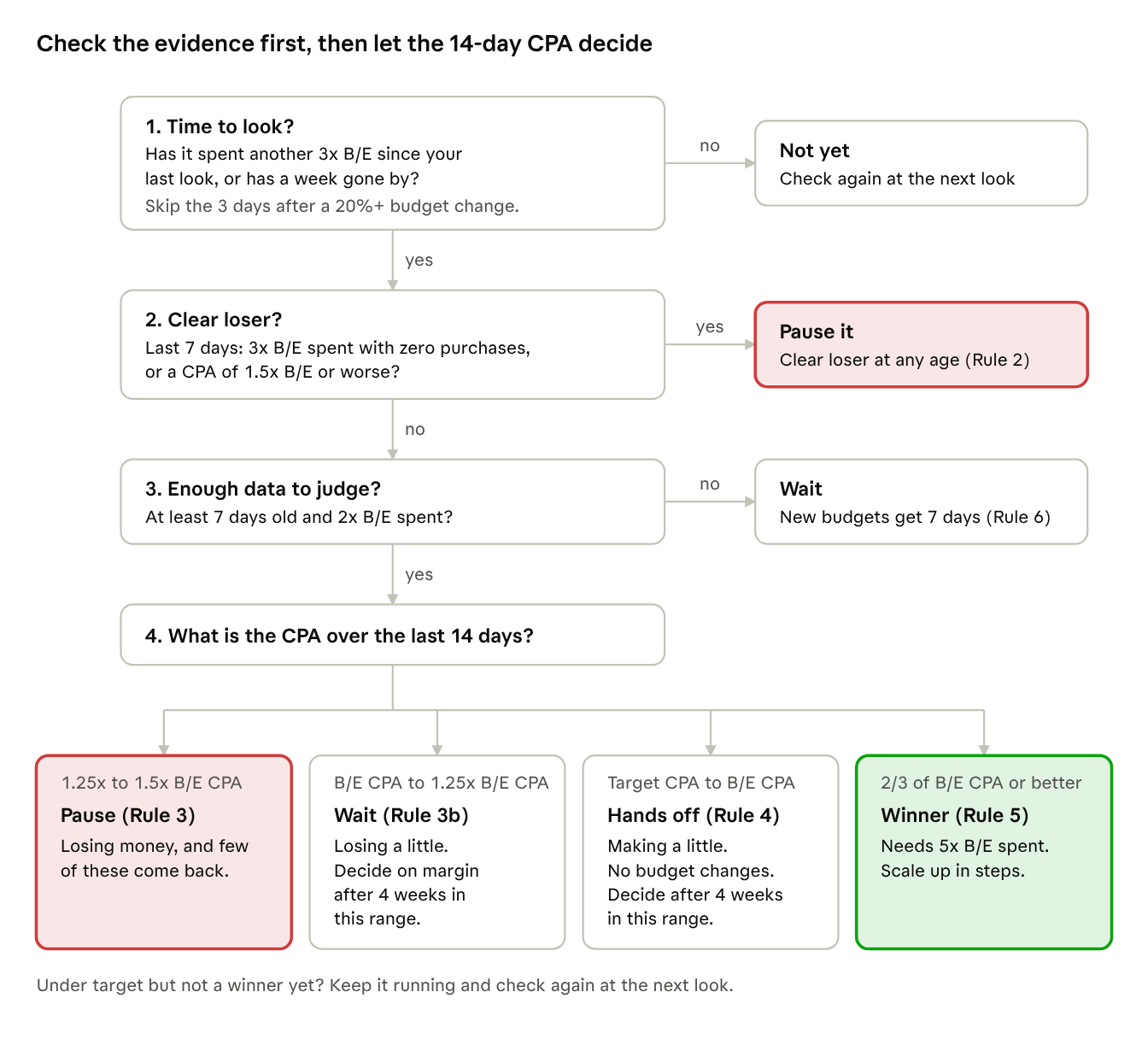
Here's what each step means, in plain English.
Rule 1: Only look when there's something new to see. Review a budget each time it has spent another 3x B/E since your last look, or once a week, whichever comes first. With a $40 break-even CPA, 3x B/E is $120. A $500/day budget spends that every 6 hours or so, so a daily look is fine. A $30/day budget takes four days. And after a budget change of 20% or more, give Meta 3 days to settle before you judge it.
Rule 2: Pause clear losers fast. If the last 7 days spent at least 3x B/E with zero purchases, or with a CPA of 1.5x B/E or worse, pause it. This works at any age, even on a brand new campaign. About 3 out of 4 of these kept losing money.
Rule 3: Losing money and not close, pause. If it's 7+ days old, has spent 2x B/E, and the 14-day CPA is 1.25x to 1.5x B/E, pause it. These came back about as rarely as the clear losers.
Rule 3b: Losing a little, wait. If the 14-day CPA is between B/E and 1.25x B/E, hold off. Enough of these recover that pausing them all cost more than it saved. If it stays in this range for 4 weeks, make the call based on your margin.
Rule 4: Making a little, hands off. If the 14-day CPA is between your target and B/E, keep it running and don't touch the budget. Cutting or raising these didn't help. If it stays in this range for 4 weeks, make the call based on your margin.
Rule 5: Call a winner only with real evidence. A 14-day CPA at two-thirds of B/E or better, with at least 5x B/E spent, makes it a candidate to scale. Raise it in steps, and remember Rule 1 after each raise.
Rule 6: New campaigns get 7 days. Before day 7, the only reason to pause is Rule 2. New campaigns usually look better in their first few days than they really are, so don't scale into a flattering first week either.
Does it actually work?
We replayed several months of real accounts and pretended each budget was paused the day a rule said so.
- Following the pause rules: about 25% less spend and about 3.6% more profit.
- The common habit (pause when last week's CPA is over break-even): about half the spend gone and about 7% less profit.
3.6% is not a magic number, and we'd rather tell you the modest truth than a flashy one. It's also very conservative: it assumes the money you pause just disappears. In real life you'd move it to a winner.
The fine print
- This assumes the system underneath is stable. The rules treat a campaign as the same campaign from week to week. A new offer, a site change, broken tracking, a holiday, or a big shift in Meta's auction all change the system, and old data stops predicting new results.
- Not every decision is a statistics decision. A brand that's about to run out of a product should pull back on it, even if the ads are working. A brand sitting on extra inventory it needs to move may happily run ads near break-even. The rules tell you what the data says. Your business still gets a vote.
- This is observational data, not a lab test. Some advertisers who cut a budget knew something we didn't.
- CPA here is what Meta reports.
- Two rules are judgment calls. The 3-day wait after a budget change and the 7-day grace period for new campaigns didn't show a clear dollar benefit in our data. We keep them because Meta needs time to settle and because they stop you from reacting to a flattering first week, and we're telling you that straight.
The bottom line
Being data driven doesn't mean reacting to every number on the dashboard. It means knowing whether you have enough data to make the call.
Patience isn't doing nothing. It's knowing what to look at, and when.