You open Ads Manager and one of your ad sets says "Learning Limited" in the Delivery column. Here's what the status actually means and what, if anything, you should do about it.
What learning limited really means
Learning Limited is a status, not an error. Meta's definition: an ad set becomes learning limited when it is unlikely to receive about 50 optimization events in the 7 days after your last significant edit.
Two words in that sentence matter more than they look.
"Unlikely." The status is a prediction, not a count. Meta can flag an ad set as learning limited the day you launch it, before it has had a chance to collect anything, if the system judges that the budget, audience, and event you chose can't produce 50 events in a week.
"Optimization events." Not conversions in general. The event you told the ad set to optimize for. If you optimize for purchases, you need about 50 purchases. If you optimize for add to cart, you need about 50 add to carts. This matters later.
Your ads keep running. Meta describes the status as a sign that your budget isn't being spent effectively because the delivery system can't optimize with the current setup. Notice what that describes: how much data Meta has to work with, not how well your ads are performing. A learning limited ad set can still be selling at or below your target cost per purchase. It just gives Meta less room to improve on what it's already doing. Whether your ad set is working is a separate question, and your cost per result and your margins answer it, not the status label.
Why 50?
Before 2017, Meta's threshold was 15 to 25 events. That year Meta raised it to 50, and it has not budged since. It has never explained where 50 comes from. In October 2026 Meta restated "roughly fifty conversions a week" in its peak-season guidance and added a claim that ad sets below that threshold ran about 28% more expensive per purchase in Meta's own analysis (PPC Land's write-up). No sample size, no time period, no control for budget. Treat the 28% as Meta's unsupported claim.
Advertisers have occasionally seen something different. Jon Loomer reported Ads Manager showing progress toward 10 events over 3 days instead of 50 over 7, and vendors have reported Advantage+ shopping campaigns exiting learning at 25 purchases. Meta never documented either, and its wording leaves room for it: ad sets exit learning "as soon as they can deliver stably," which "usually" happens around 50. Fifty is a sufficient condition, not a necessary one.
Whatever Ads Manager shows, 50 is a sensible floor for a different reason. Below roughly 50 events, week-to-week variations in your results are dominated by noise. You can't tell whether a change helped or whether you got lucky. We've written about why that's true in the 50 conversions post, and the argument doesn't depend on Meta's rule at all. It's just arithmetic.
Why 7 days?
Meta doesn't say. Two intuitions hold up.
First, a week smooths day-of-week effects. Most ecommerce stores sell differently on a Tuesday than on a Saturday, and any shorter window would be measuring the calendar in addition to the ads.
Second, Meta already thinks in weeks. Your daily budget is really a weekly budget divided by seven; Meta will overspend some days and underspend others as long as the week nets out. We covered that in the daily budget is weekly post. A learning window that matches the budgeting window is the obvious choice.
Another thing to keep in mind: the clock restarts at every significant edit. "Seven days" means seven days since you last touched the ad set, not seven days since launch.
Diagnose before you fix
Here is where most advice on this topic goes wrong. It jumps straight to fixes without asking which problem you have. There are two, and they have opposite solutions.
Start by adding the Optimization events column in Ads Manager (Columns, Customize columns, check Optimization events). Then total the events across every ad set in the account for the last 7 days.
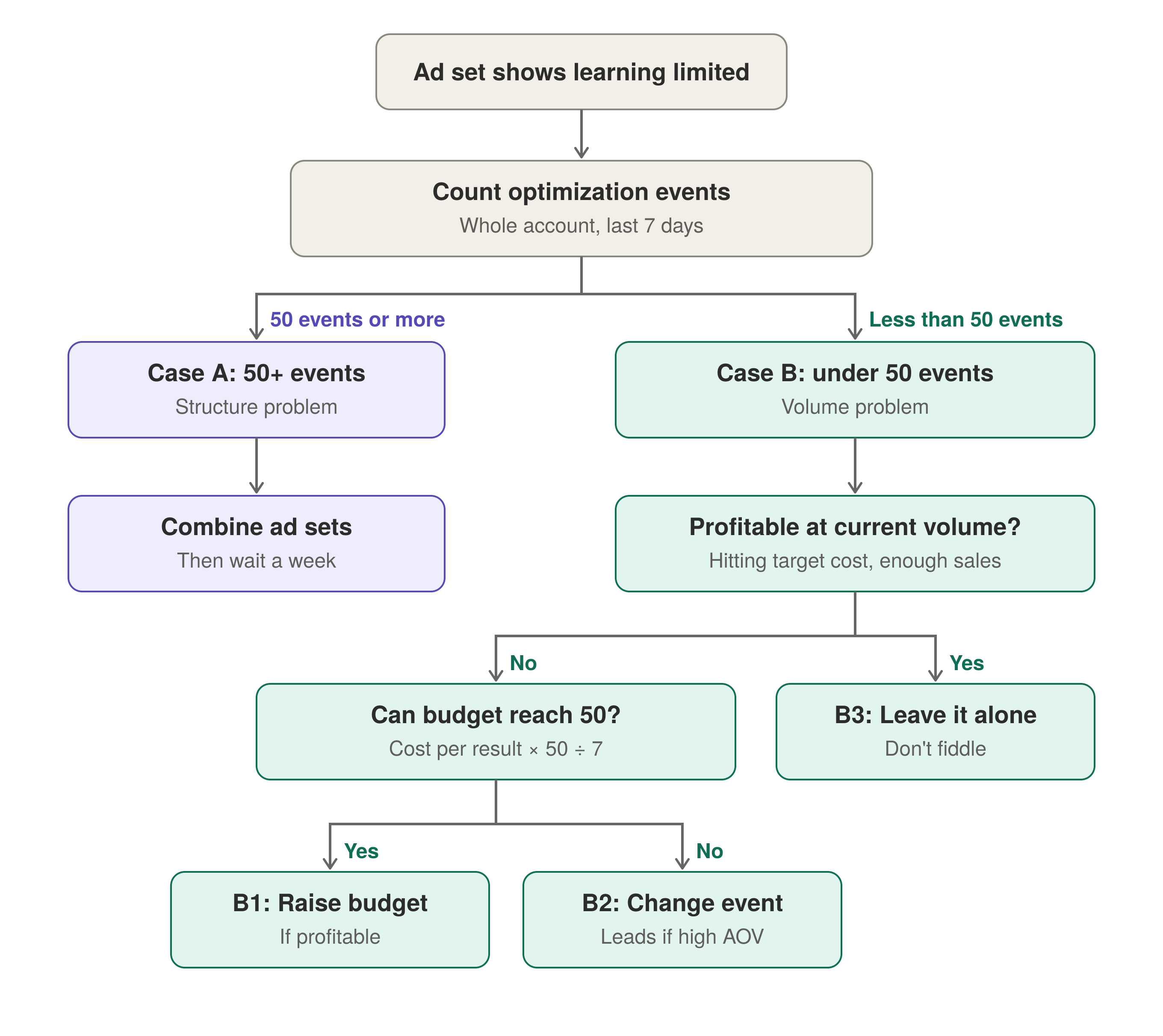
Case A: 50+ events a week across the account, spread across several ad sets
You have a structure problem, not a volume problem. Your account produces enough signal; you've split it into pieces too small for any one ad set to learn from.
The question is whether each ad set earns its existence. Legitimate reasons for a separate ad set:
- You need separate budget control by product line or geography.
- You need to cap remarketing spend so Meta doesn't dump your budget on people who were going to buy anyway.
- You're near the 50-ad cap in one ad set and need another for organizational reasons.
- You have a genuinely different business goal for that ad set.
Not a legitimate reason: separate audiences or personas with the same creative and the same optimization event. Meta calls this audience fragmentation, says it makes your ads less efficient, and offers an automated rule that will combine fragmented ad sets for you. Different audiences used to be the main reason for multiple ad sets. Now that Meta's targeting has gone broad and does most of the audience-matching inside a single ad set, that reason has mostly evaporated.
Ask what the split actually buys you. If the ad sets sit in a campaign using Advantage campaign budget (formerly CBO), they already share one budget, and Meta moves money between them as it sees fit. In that setup a second ad set with the same creative and the same event gives you no extra control, only fragmentation.
There's a second cost to fragmentation that Meta documents but most people miss. When ad sets target overlapping people, ads from different ad sets qualify for the same auctions. Meta enters only one of your ads, the one it predicts has the highest total value, and your other ads sit that auction out. Meta frames this as a feature: your ads never bid against each other. The quieter consequence is that ad sets whose ads keep losing the internal pick enter fewer auctions, spend less, collect fewer events, and stay learning limited. This happens across separate ad accounts too, so opening a second account doesn't help.
The fix is to combine ad sets. Note that combining is itself a significant edit and restarts learning. Do it once, then leave the result alone for a week.
Case B: fewer than 50 events a week across the whole account
Consolidation can't manufacture volume. Before reaching for any fix, ask two questions, in this order.
First: are you profitable at your current volume?
If the ad set is hitting your target cost per purchase and producing enough sales for the business, you may not have a problem at all.
B3: Yes. You're profitable and happy with the volume. Leave it alone.
Meta says learning limited isn't a penalty, and an ad set that sells at your target cost is doing its job. Every edit restarts the clock, so the worst thing you can do is fiddle.
Second: if not, could this account ever reach 50 of this event per week at a budget that makes sense?
Do the math. Cost per result times 50, divided by 7, is the daily budget required. For a $30 cost per purchase that's about $215 a day. For a $300 cost per purchase it's over $2,000 a day.
If the number is far outside what the business can spend profitably, this isn't a learning limited problem you can fix with budget. It's a sign the optimization event is wrong for the business.
B1: Yes. Raising the budget makes sense. You're just underfunded.
This is the case where the ads are profitable but you want more sales than the current budget delivers.
- Raise the budget toward the number, but only if the ads are profitable at current cost per result. Scaling unprofitable ads just loses money faster.
- Increases over 20% restart learning. Either step up in smaller increments or make one jump and accept the reset.
- Check audience size. Meta flags audiences under 2 million as a common cause of learning limited, and broadening costs nothing.
B2: No. You can't raise the budget enough. Change what you're optimizing for.
Meta's suggestion is a more frequent event, with add to cart as the example. The risk is that Meta then finds people likely to add to cart, not people likely to buy, and for ecommerce that usually hurts.
For high-AOV products there's a better version of the same move: optimize for leads.
- Expensive purchases have longer sales cycles. Meta's default attribution is 7-day click, so a buyer who takes two weeks to decide doesn't register as a Meta purchase at all. If you optimize for purchases, Meta is learning from the fast deciders, a biased minority.
- A lead (an email or SMS opt-in) happens earlier, happens more often, and hands you the contact. You run the longer persuasion yourself through email and remarketing, on your own timeline instead of inside Meta's attribution window.
- Unlike add to cart, a lead is an asset you own.
The caveats, stated plainly:
- Meta will find form-fillers, not buyers. Track your lead-to-purchase rate and compute effective cost per purchase (cost per lead divided by lead-to-purchase rate). If that doesn't beat what purchase optimization was giving you, stop.
- This only works if the email program and remarketing audiences actually exist. Leads nobody nurtures are just a more expensive way to be learning limited.
- The quality problem moved downstream. It didn't disappear.
The bottom line
Learning limited means there isn't enough data for Meta to optimize delivery. It does not mean your ads can't work. Judge the ad set on cost per result and return against your own margins, not on the status label in Meta's Ads Manager.
Learning limited tells you one of three things: your budget is fragmented, your budget is too small, or your optimization event doesn't fit your business. Figure out which before you touch anything. Then make your adjustments and let them collect enough data to support a statistically informed decision.