TL;DR
- Your "daily" budget is really a weekly budget ÷ 7, Meta paces to the calendar week, starting Sunday.
- Sunday runs ~14% hot, Saturday ~14% light. That's normal, not broken.
- Make budget changes early in the week and/or day
Meta's pacing looks random (but it's not)
You set a campaign to $50 a day. You check yesterday: it spent $38. You check today: it's on pace for $71. Nothing changed: same creative, same audience, same targeting. So you start poking. Did the algorithm break? Did a competitor flood the auction? Should you pause and reset?
You should do none of those things, because nothing is wrong. You're reading the wrong clock. Meta isn't trying to spend $50 today. It's trying to spend $350 this week, and $38 yesterday plus $71 today is how it's getting there.
Your daily budget was never daily. The number you type into Ads Manager is a weekly budget wearing a daily costume. Meta divides the week into seven and shows you one-seventh, but the unit it actually manages is the week. Judge a single day against that daily number and you will misread a healthy campaign as a broken one.
The Real Unit Is a Calendar Week, Sunday to Saturday
This is not a theory. It is Meta's stated behavior, documented in a help page most advertisers never find. In Meta's words: "Your charges average out over a calendar week (Sunday to Saturday), and you won't spend more than 7 times your daily budget for every week ending Saturday at midnight."
Read that carefully, because two things in it matter more than they look. First, the week is a fixed calendar week. It starts Sunday and ends Saturday, no matter when you launched or last touched the campaign. It is not a rolling seven days. Second, "7 times your daily budget" is a ceiling, not a target for any given day. Some days run hot, some run cold, and the week is what has to add up.
Think of it like a weekly grocery budget rather than a daily one. If you give yourself $350 for the week, you don't spend exactly $50 every day. You spend more when the good stuff is on sale and less when it isn't, and what matters is that the week lands near $350. Meta runs your ad budget the same way, with one strict rule: it will not blow past the weekly total.
How the weekly math works. Your daily budget is really weekly budget ÷ 7. Across a normal week, Meta spends up to that weekly total but treats it as a hard cap. It almost never goes over. On any single day it is allowed real slack: up to 25% over a standard daily budget, and up to 75% over for a promotional or scheduled budget, as long as the Sunday-to-Saturday week still averages out to no more than seven times the daily number.
When we measured this across thousands of campaign-weeks, the discipline was almost startling. In a typical week where the budget was left alone, spend landed within a fraction of a percent of the weekly total. And it essentially never went over: in 95 out of 100 weeks, spend came in at or below the budget. The only real misses were on the low side: campaigns whose audience was too small or bids too low to spend the full amount. Meta hits the ceiling or falls short of it. It does not break it.
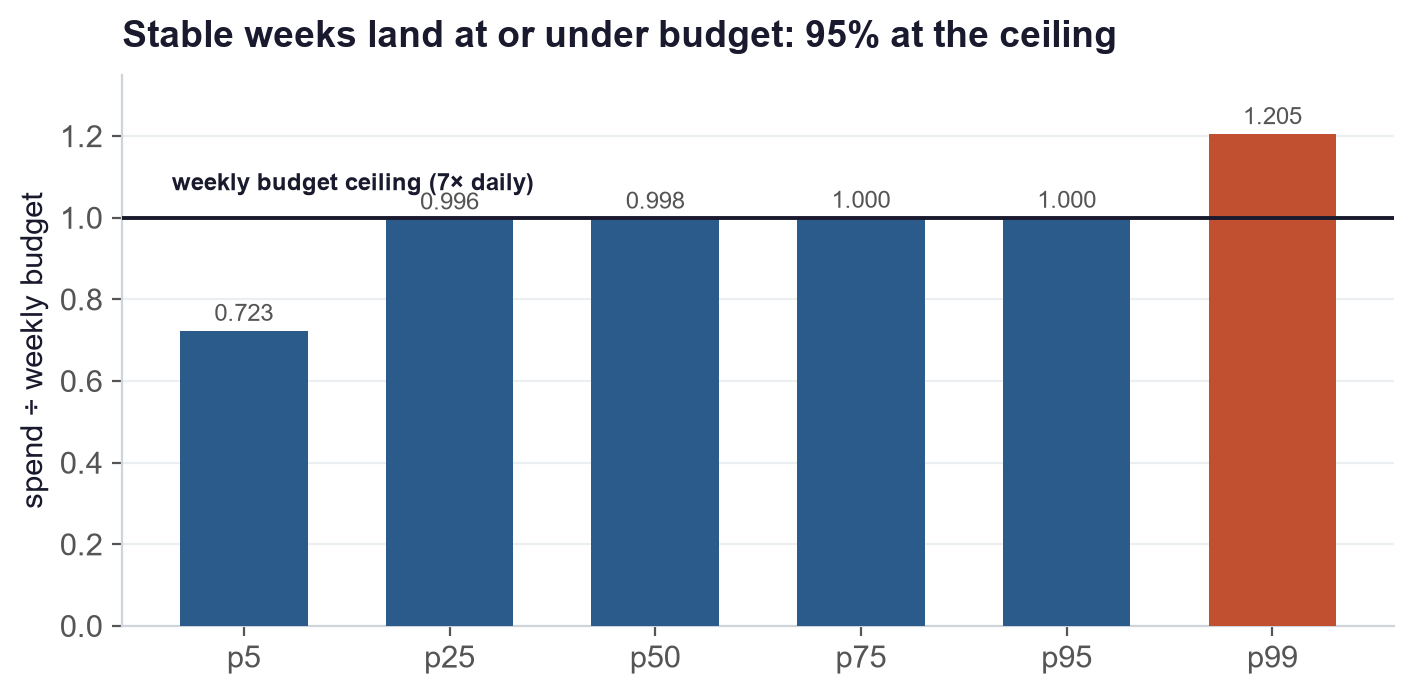
Weekly spend as a share of the weekly budget, across stable-budget weeks. Nearly every week lands right at the ceiling or below it; the low end is the underspend tail — campaigns that couldn't deliver the full budget, not Meta missing the target.
Meta Front-Loads Sunday
Here's the part Meta doesn't publish, and the part that explains most of the "why did it spend so much today" panics. The weekly total isn't spread evenly. Meta spends hardest on Sunday, the first day of its week, and eases off through Saturday.
Measured across the same campaigns, Sunday runs about 14% above the weekday average, then tapers down every day until Saturday, the lightest day of the week. The week still adds up to budget; Sunday is just borrowing from later in the week, not from next week.
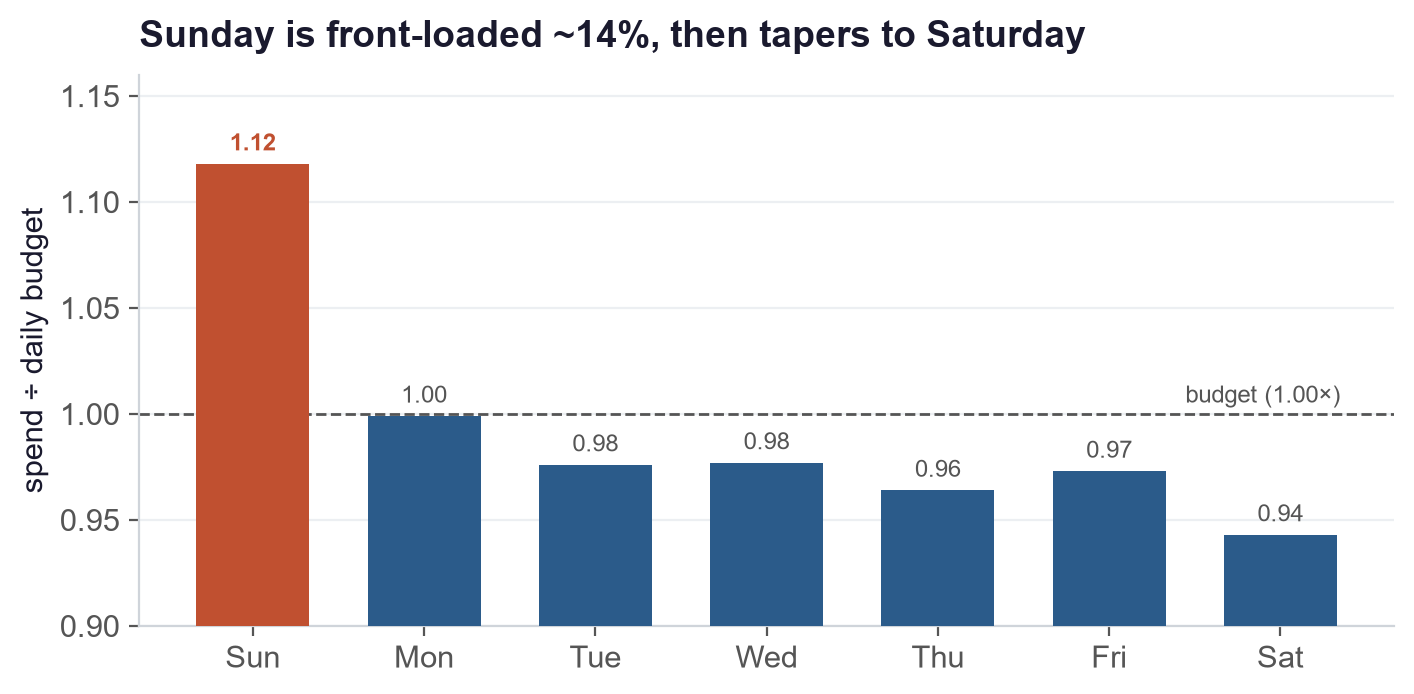
Spend as a share of the daily budget, by day of Meta's week. Sunday runs hot and Saturday runs light, but the seven days still sum to the budget.
So if you glance at a campaign on Sunday afternoon and it's pacing well over your daily number, that isn't a malfunction. That's Tuesday. The system is doing exactly what it does every week; you just happened to look on the day it spends the most.
A Budget Change Doesn't Take Full Effect Today
The second great source of confusion is what happens when you change a budget mid-week. You raise it in the afternoon, watch the rest of the day, and the spend barely moves. It looks like Meta ignored you.
It didn't. A budget change applies to the remaining part of the day, not the whole day. Change it at noon and roughly the back half of the day runs on the new number. Change it at 9 p.m. and almost none of the day does, because the day was already mostly spent. Meta documents this too, in the same buried help page: a mid-week change makes it "calculate a new amount to spend for the rest of that week, based on the new budget and the amount of time remaining," and it takes about 15 minutes to apply.
We measured the exact shape of it, and it's close to a straight line: the earlier in the day you make the change, the more of that day runs on the new budget. A morning change lands almost fully; an evening change barely registers until tomorrow.
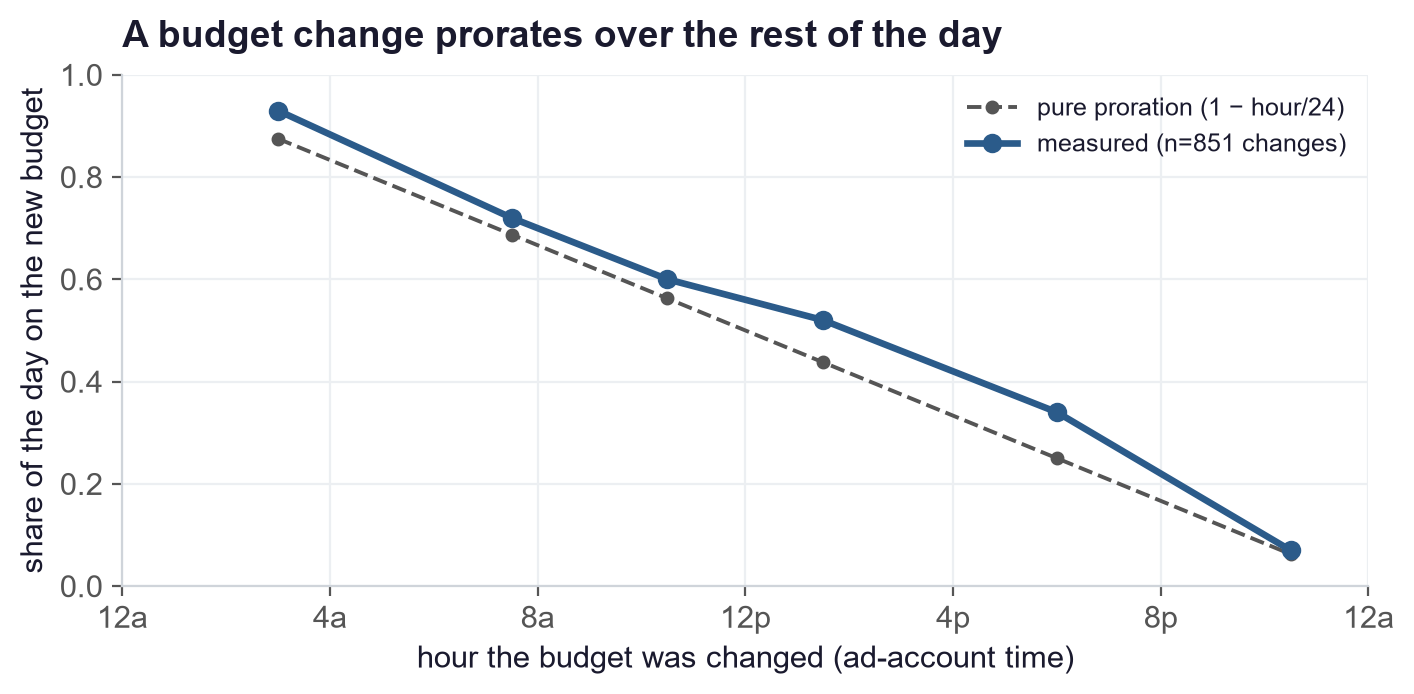
How much of the day runs on the new budget, by the hour you made the change. Earlier changes take fuller effect the same day; a late change mostly lands the next morning.
This is why a raise so often "does nothing" the day you make it, then shows up the next morning. Nothing was ignored. You just gave the instruction late in a day that was already mostly paced.
The Trap: Raising Budget on Friday or Saturday
Put the three facts together and a specific, expensive mistake falls out.
Suppose you raise a budget on Friday or Saturday. By then, Meta's week is almost over and nearly spent, so there's very little "rest of the week" left for the increase to work with, and it barely lifts spend before Saturday midnight. It looks like the raise flopped. So the following week opens on Sunday with the new, higher weekly allowance in full, and Sunday is exactly the day Meta front-loads. The increase you thought did nothing lands all at once as a Sunday-into-Monday spike.
The Friday raise that spends nothing, until it spends everything. Raise a budget late in the week and it can't work that week; the money rolls into next week's allowance and hits on Sunday, when Meta spends hardest. Worse, if you react to the quiet Friday by cutting the budget back mid-week, you've lowered the target after Sunday already spent aggressively against the higher one, locking in an overspend you can't take back. You can't un-spend Sunday.
And no, the shortfall doesn't get "made up" later in a way you can steer. We looked specifically at campaigns that underspent and then got a raise: the following week ran at a perfectly normal level, with no repayment of the earlier gap. Each Meta week is settled within itself. What happens in one week does not carry into the next.
What to Actually Do
Read the week, not the day. Before you touch anything, add up Sunday-through-today against that many days of budget. A single day over or under tells you almost nothing; the week-to-date tells you whether pacing is actually off.
Time your increases for early in the week. If you want a raise to spend promptly and smoothly, make it Sunday or Monday, when there's a full week for Meta to work it in. A Friday raise mostly buys you a Sunday spike you didn't plan for.
Don't panic at a hot Sunday or a flat post-raise afternoon. Both are the system working normally. A Sunday running 10–15% over the daily number is routine. A raise that appears to do nothing the day you make it will usually show up tomorrow.
If you must change budgets mid-week, change them in the morning. An early change takes fuller effect that day; a late one mostly waits for tomorrow. If timing matters, don't do it at night.
A Note on Why Sunday (Our Best Guess)
Meta doesn't say why the week starts Sunday or why Sunday runs hottest, so this part is informed speculation, not documented fact. Two forces probably combine.
One is demand: e-commerce buying is weekend-heavy. But our order data only half-supports a Sunday story. The weekend is clearly the strong block, yet Saturday and Friday actually out-order Sunday. If demand were the whole explanation, Meta would front-load Friday, not Sunday.
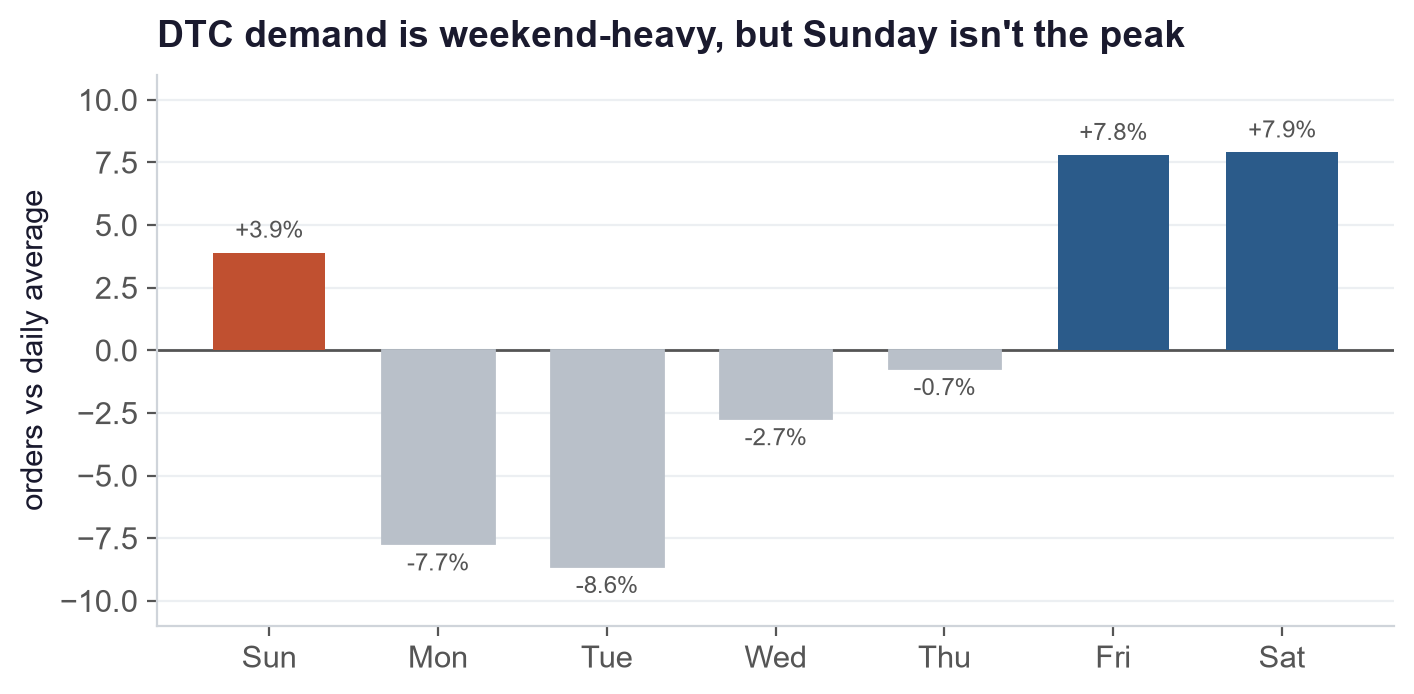
E-commerce orders by day of week, versus the daily average. The weekend leads, but Saturday and Friday beat Sunday, so demand explains the weekend tilt, not the Sunday spike specifically.
The stronger reason is mechanical. Meta has to land the week at or under budget, and its two levers aren't equally easy to pull. Spending less is trivial: it just enters fewer auctions. Spending more is hard: it has to find additional auctions you'll actually win at a reasonable price, which depends on inventory and competition it doesn't control. Front-loading early and coasting down is the safe way to hit a target you can always throttle but can't always accelerate. It's easier to tap the brakes at the end of the week than to floor it and hope the road appears.